











Every raider in ARC Raiders quickly learns that survival is not just about marksmanship — it’s about management. Materials drive every meaningful step of progress, from completing story quests to unlocking end-game projects. Each raid fills your backpack with potential: wires, batteries, scrap alloys, rusted tools, and sometimes mysterious ARC components. The challenge isn’t finding materials; it’s knowing which ones matter and when.
This comprehensive guide breaks down the entire resource economy into three clear categories: materials you should save for quests, materials worth stockpiling for long-term projects, and materials that are safe to recycle or sell. Whether you’re just beginning or optimizing late-game runs, understanding this system will spare you wasted hours of farming and prevent the painful mistake of selling something irreplaceable.
How the Material System Works
Materials in ARC Raiders follow a consistent internal logic. Every item belongs to one of several environmental pools — Electrical/Technological, Mechanical, or Old-World/Industrial — which determine where it spawns. Electrical areas such as server rooms and power plants produce wires, batteries, and heat sinks. Mechanical zones, like depots or garages, are rich in metal parts and tools. Old-World ruins yield plastics, fabric, and consumer junk.
Each item also carries a rarity tier: common, uncommon, rare, or epic. Common materials like Plastic Parts or Metal Parts appear everywhere and serve as bulk ingredients. Uncommon materials, such as ARC Alloy or Electrical Components, show up less frequently and become bottlenecks for crafting and projects. Rare and epic items — Flow Controller, Magnetron, Leaper Pulse Unit — often appear only in specific quest chains or enemy drops.
The total economy is deliberately tight. Fully upgrading everything in ARC Raiders requires over 1,190 individual items across more than sixty unique materials. This pressure forces you to make decisions: what to carry, what to store, what to break down.
Recycling adds another layer. Most “damaged” or “recyclable” items can be dismantled into sub-components. For instance, a Damaged Heat Sink breaks down into several Metal Parts and Wires. A Damaged ARC Motion Core yields ARC Alloy. The game rewards players who think like engineers, transforming surplus junk into the precise parts they’re missing.
Materials to Save for Quests

Quests often require very specific materials. Unlike crafting, these are not optional — without them, the storyline halts. Many players make the mistake of recycling these items early because they seem ordinary, only to discover they must grind again later.
Early Quest Essentials
One of the first major missions, Trash into Treasure, teaches this lesson. Shani asks you to deliver six Wires and one Battery. Both are labeled as “Uncommon”, but they’re easy to underestimate. Wires appear mainly in Electrical or Technological interiors such as the Control Tower, Research & Administration, and Power Generation Complex on the Dam Battlegrounds. Batteries come from similar sources or by recycling mid-tier electronics like cooling fans and power cables.
Because these two items are also used later in repairs and crafting, players should maintain a constant buffer of at least 10–12 Wires and 2–4 Batteries. Keeping a small stack in your safe pocket ensures you never stall a quest.
Another early mission, Flickering Threat, requires four Wires to restart a generator. It’s a simple objective that becomes frustrating only for those who sold their spare wires the day before. Preparation saves time.
Mid-Game and Rare Quest Items
Further into the campaign, the mission Snap and Salvage (given by Tian Wen in Stella Montis) demands two rare components: a Flow Controller and a Magnetron. Both drop only from specific storage units in Stella Montis or nearby checkpoints. Their spawn rate is low, and they’re often lost if carried unsecured. Always place them into your Secure Pocket immediately upon pickup.
Rare quest items also include ARC-themed tech like Snitch Scanners or Sensor Modules, which occasionally appear in side contracts. These are not consumed once turned in, but holding onto at least one spare prevents headaches if a similar task appears later.
Core quest materials you should always save include:
- Wires – Used in multiple early repairs and turn-ins.
- Battery – Appears in early and mid-tier quests.
- ARC Alloy – Sometimes required for ARC-related objectives.
- Flow Controller – Rare turn-in for Snap and Salvage.
- Magnetron – Epic rarity; same quest, critical drop.
- Snitch Scanner / Sensor Module – Side-quest electronics.
Maintaining a small, organized “quest buffer” in your stash is the most efficient way to avoid repeating raids for missing components. Label or separate them by rarity so you don’t recycle them accidentally.
Materials to Save for Projects
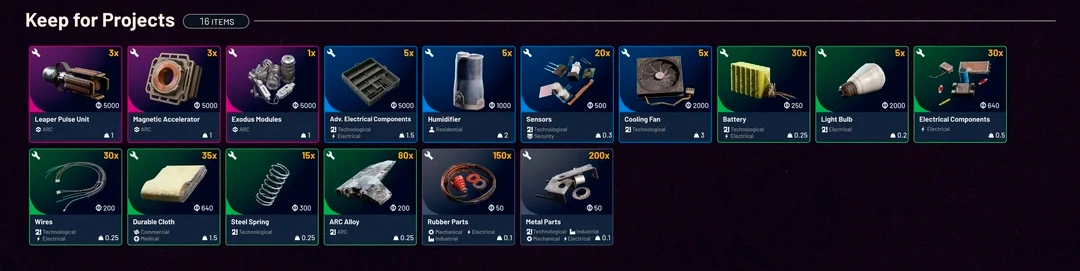
Once the campaign progresses beyond simple errands, ARC Raiders introduces projects — long-term construction or expedition goals that require huge material quantities. These objectives often define the mid-to-late-game grind, and unlike quests, they demand volume rather than rarity.
A typical Expedition Project might consume:
- 150 × Metal Parts
- 200 × Rubber Parts
- 80 × ARC Alloy
- 30 × Wires
- 30 × Electrical Components
- 30 × Batteries
- 20 × Sensors
- 5 × Advanced Electrical Components
- 5 × Leaper Pulse Units
The pattern is clear: projects rely heavily on common and uncommon resources in massive numbers, spiced with a handful of rarities. If you wait until the project appears to start collecting, you’ll face an exhausting grind. The smarter tactic is to build a project stockpile from the very beginning.
Start each raid with two mindsets — “quest ready” and “project prep.” Pick up and store all Metal Parts, Rubber Parts, Plastic Parts, ARC Alloy, and Electrical Components. These five categories form the backbone of almost every large-scale project. Even if they seem abundant now, later tasks can ask for hundreds.
Recommended Project Stock Levels
- Metal Parts: 150–200 units minimum.
- Rubber Parts: 200+ units; heavy industrial use.
- ARC Alloy: 60–100 units; rarer but crucial.
- Wires / Batteries / Electrical Components: 30+ of each for balance.
- Plastic Parts: 100–150 units; filler material in many recipes.
- Rare Additives: Keep at least 2–5 Leaper Pulse Units and Advanced Electrical Components in reserve.
Building these buffers during routine play ensures that when a new project unlocks, you can complete it immediately instead of grinding low-tier zones for days.
Efficient Farming for Project Resources
Mechanical and industrial zones — scrapyards, garages, maintenance yards — are prime for Metal Parts and Rubber Parts. Old-World ruins yield Plastic Parts and Fabric. ARC combat zones and machine wrecks are the best source of ARC Alloy. For Electrical Components and Wires, stick to power facilities or data centers.
To optimize, chain your raids through zones tagged with the material type you need. The in-game HUD displays zone categories when you enter an area; learning them allows you to plan “resource circuits.”
Materials to Recycle or Sell
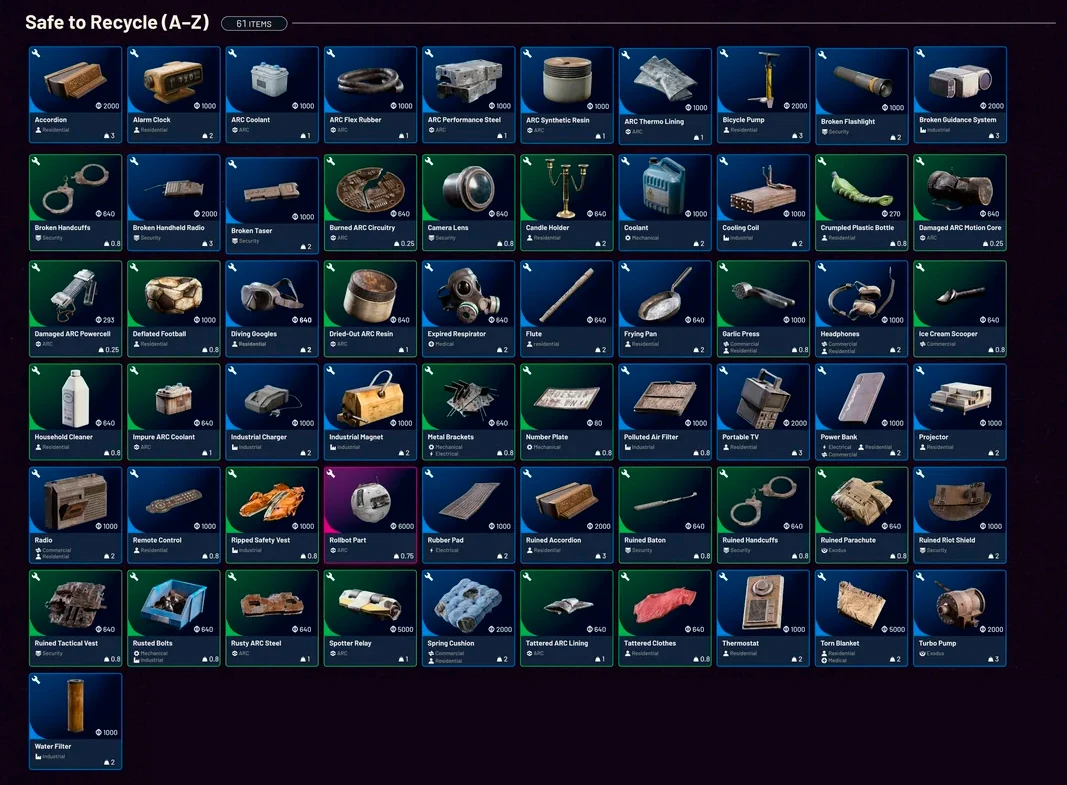
The other half of inventory management is knowing what not to keep. Not every shiny object is valuable, and hoarding everything clogs your stash and slows down decision-making.
The rule of thumb: If it doesn’t serve a quest, project, or crafting recipe — recycle it. The ARC Raiders economy actually rewards recycling because it converts decorative or flavor items into base components you’ll use constantly.
Items marked as Recyclable in their description can be dismantled safely. The yield depends on item type: consumer electronics produce Wires or Electrical Components, mechanical gadgets yield Metal Parts, and ARC tech can output ARC Alloy.
Common Safe-to-Recycle Items
- Alarm Clock
- Portable TV
- Bicycle Pump
- Cracked Tablet
- Remote Control
- Damaged Cooling Fan
- Broken Handheld Radio
These trinkets are purely environmental and serve no quest or project function. Recycling them on-site can free inventory space mid-raid, though remember that in-raid recycling gives reduced yields compared to safe-zone dismantling.
Managing Surplus Stock
Even useful materials become clutter when overstocked. Once you exceed your buffer levels — for example, more than 150 Plastic Parts or 12 Wires — it’s efficient to recycle extras into something rarer or sell them for currency. Keeping your inventory lean prevents decision paralysis during raids and makes it easier to track what you truly need.
The Dynamic Balance: When to Keep, When to Break Down
ARC Raiders constantly tests your judgment. Should you hang onto that damaged circuit board in case a quest appears, or break it down into metal now? The answer depends on two questions:
- Is the item mentioned in a quest or project list you’re pursuing? If yes, keep it.
- Is the item common and easily farmable? If yes, recycle the excess.
For example, Damaged Heat Sink sits in the middle. It’s technically rare and used in some upgrade chains, but it’s also a high-yield recyclable producing Metal Parts and Wires. Keeping two to four in storage and recycling the rest strikes the perfect balance between preparedness and efficiency.
Similarly, ARC Alloy is valuable for both quests and projects, so never recycle it even if you have plenty — future missions will consume it in bulk.
Recycling as a Resource Engine
Rather than treating recycling as cleanup, view it as a manufacturing process. You can intentionally collect recyclable junk to convert into materials that are otherwise scarce. For example, if you’re short on wires before a quest, grab extra Cooling Fans, Power Cables, or Damaged Heat Sinks and recycle them back at base. This approach turns any raid, even one without direct quest objectives, into a productive resource run.
Experienced players even categorize their loot by recycling yield rather than by item type. A room full of broken electronics is essentially a wire factory; a scrapyard is a metal refinery. Once you shift to that mindset, you stop seeing “junk” and start seeing opportunity.
Stage-Based Material Strategy
Recommended Keep Levels Summary
| Category | Material | Recommended Quantity / Action | Notes / Purpose |
|---|---|---|---|
| Quest Essentials | Wires | 10–12 | Needed for early quests (Trash into Treasure, Flickering Threat) |
| Batteries | 2–4 | Power restoration and repair objectives | |
| ARC Alloy | 10–12 | Required in several ARC-related missions | |
| Flow Controller | 1 | Rare turn-in for Snap & Salvage quest | |
| Magnetron | 1 | Epic quest item, same mission as Flow Controller | |
| Snitch Scanner | 1 | Occasional quest electronics item | |
| Project Stockpile | Metal Parts | 150–200 | Heavy use in long-term projects and upgrades |
| Rubber Parts | 200 | Bulk material for industrial-scale tasks | |
| ARC Alloy | 80 | Common mid-rare alloy; keep for expeditions | |
| Plastic Parts | 100–150 | Used as filler material in various projects | |
| Electrical Components | 30 | Consumed in late-stage builds and repairs | |
| Wires | 30 | Needed in both quests and project crafting | |
| Batteries | 30 | Energy source for higher-tier projects | |
| Leaper Pulse Unit | 5 | Rare ARC drop, keep for end-game projects | |
| Recycle / Sell | Decorative Trinkets | — | Alarm Clock, Portable TV, Remote Control — purely cosmetic |
| Damaged Electronics | — | Safe to recycle once you have wire/metal surplus | |
| Surplus Commons | — | Recycle or sell any excess above buffer limits |
Common Mistakes and How to Avoid Them
- Selling quest items prematurely.
Players often sell Flow Controller or Magnetron before realizing they’re mandatory for quests. If you’re uncertain about an item’s purpose, store it. - Ignoring safe pockets.
Always secure rare finds. Losing them on death forces you to refarm. - Hoarding everything.
A cluttered inventory hides valuable items and slows you down. Limit yourself to planned buffer amounts. - Recycling without checking rarity.
Some “damaged” items are rarer than they look. Check color coding or rarity markers before dismantling. - Failing to plan raids by zone.
Random looting wastes time. Learn which areas correspond to which material pools and plan efficient routes.
The Philosophy of Material Management
Efficient resource handling in ARC Raiders is less about memorization and more about mindset. The game’s world is designed to reward intention. Every object you pick up is part of a closed economy that connects raids, crafting, and progression. When you begin thinking of each raid as a targeted operation — today for wires, tomorrow for rubber, next week for ARC alloy — the grind transforms into strategy.
By building structured reserves, you create momentum. By recycling wisely, you maintain flexibility. By selling clutter, you regain clarity. The result is a playstyle that feels deliberate and rewarding instead of chaotic.
From Scavenger to Strategist: The True Power of Materials
Materials are the silent engine behind every victory in ARC Raiders. They dictate your ability to finish quests, launch projects, and sustain the constant cycle of raid and return. Treat them with the same attention you give to weapons or tactics.
Keep quest items like wires, batteries, and rare controllers safe; they unlock the story. Build a project stockpile of metals, rubbers, and alloys to prepare for future demands. Recycle or sell non-essential items to keep your stash efficient. Plan your raids according to material zones, maintain clear buffer targets, and never underestimate a piece of scrap — it might be the key to your next breakthrough.
Master this economy, and ARC Raiders stops being a scavenger’s struggle and becomes a strategist’s playground.
