











Before Project Resolve landed with Title Update 20 in February 2024, the Division 2 weapon meta was predictable to the point of being boring. Most agents ran the same handful of weapons — St. Elmo’s Engine, a solid AR, maybe a sniper — because everything else simply couldn’t keep up. Massive Entertainment knew it, the community knew it, and Project Resolve was supposed to fix it.
The update did a lot of things at once: thousands of bug fixes, Dark Zone overhauls, a brand new Tinkering Station, mod system changes. But buried inside all of that was a weapon and gear balance pass that quietly reshaped which builds are worth running in endgame content. Some buffs were minor. A few were genuinely game-changing.
This guide focuses on three specific changes that matter most right now in 2026 — the flat damage buff to LMGs, the brand set rework, and a reconfiguration system for exotic weapons that players are still sleeping on. If you’re building for Heroic or Legendary content, all three deserve a spot in your loadout planning.
Division 2 Project Resolve: The Flat 20% LMG Damage Buff Explained
LMGs have always had a case on paper. High ammo capacity, sustained fire, decent range. But in practice, before TU20, the damage output just didn’t justify the tradeoffs — slow weapon swaps, heavy handling penalties, and base damage that lagged behind assault rifles in most situations. Players who wanted raw DPS picked ARs. LMGs were a niche choice at best.
Project Resolve changed that with one of the cleanest fixes in the patch: a flat +20% weapon damage increase applied across almost every standard LMG in the game. Not a conditional buff, not a talent rework — just a straight damage number increase baked into the base stats.
Here’s which weapon families got the buff:
| LMG Family | Buff Applied |
|---|---|
| M249 B / Tactical M249 Para / Military Mk46 variants | +20% Weapon Damage |
| Classic M60 / Military M60 E4 / Black Market M60 variants | +20% Weapon Damage |
| MG5 / Infantry MG5 variants | +20% Weapon Damage |
| Classic RPK-74 / Military RPK-74 / Black Market RPK-74 variants | +20% Weapon Damage |
| Named & Exotic LMGs (Iron Lung, The Stinger, etc.) | Case-by-case — not guaranteed |
That last row matters. Massive deliberately held back some of the buff from named and exotic LMGs to avoid accidentally breaking the balance on weapons that already had strong talent synergies. So if you’re running The Stinger or Black Friday, don’t assume you got the same boost — check your actual damage numbers in the Shooting Range.
For standard LMGs, though, the math shifted meaningfully. The M60 line in particular benefits from this because it already had strong base magazine sizes. With 20% more damage on top, sustained DPS over a full mag now competes directly with AR output in the 15–40 metre range that most Heroic and Legendary content is played at. The RPK-74 variants are worth revisiting too — lighter handling than the M60 with the same damage bonus, which makes them more forgiving when you’re getting rushed by elites.
The short version: if you wrote off LMGs before TU20, they’re worth testing again. The 20% isn’t a subtle adjustment.
Buy services for
The Division 2!
Get help with the parts of the game that take the most time. Browse available services or place a custom order.
Order
Division 2 Brand Set Rework After Project Resolve: Why 3-Piece Bonuses Are Finally Worth It
One of the core complaints about Division 2 builds before Project Resolve was that brand set bonuses weren’t strong enough to justify committing multiple gear slots to the same manufacturer. The smarter move was almost always to mix brands — grab whatever gave the best raw stats on each slot and ignore the set bonuses entirely. Massive acknowledged this directly in their Project Resolve announcement, stating the goal was to make 2- and 3-piece bonuses rewarding enough that players actually want to build around them.
The rework touched bonuses across multiple brand sets, tightening the gap between “mixing for stats” and “committing to a set.” The 3-piece bonus specifically received the most attention, since that’s the slot that required the most commitment and delivered the least return.
For LMG-focused builds, this matters because several brand sets with LMG-relevant bonuses are now much more attractive as a 3-piece commitment. A single example worth highlighting: stacking a brand set that offers weapon damage, magazine capacity, or sustained fire bonuses across three pieces now actually moves the needle on your overall DPS in a way it simply didn’t before TU20.
A few things worth knowing about how the rework affects build planning:
The key shift here isn’t any one specific stat number. It’s that brand set bonuses went from being an afterthought to being a real decision point when you’re building a loadout. For sustained LMG builds especially, stacking a relevant brand to 3 pieces is now one of the cleaner ways to push damage without relying entirely on gear set mechanics.
Division 2 Exotic Weapon Reconfiguration: The Underrated Project Resolve Buff Most Players Ignore
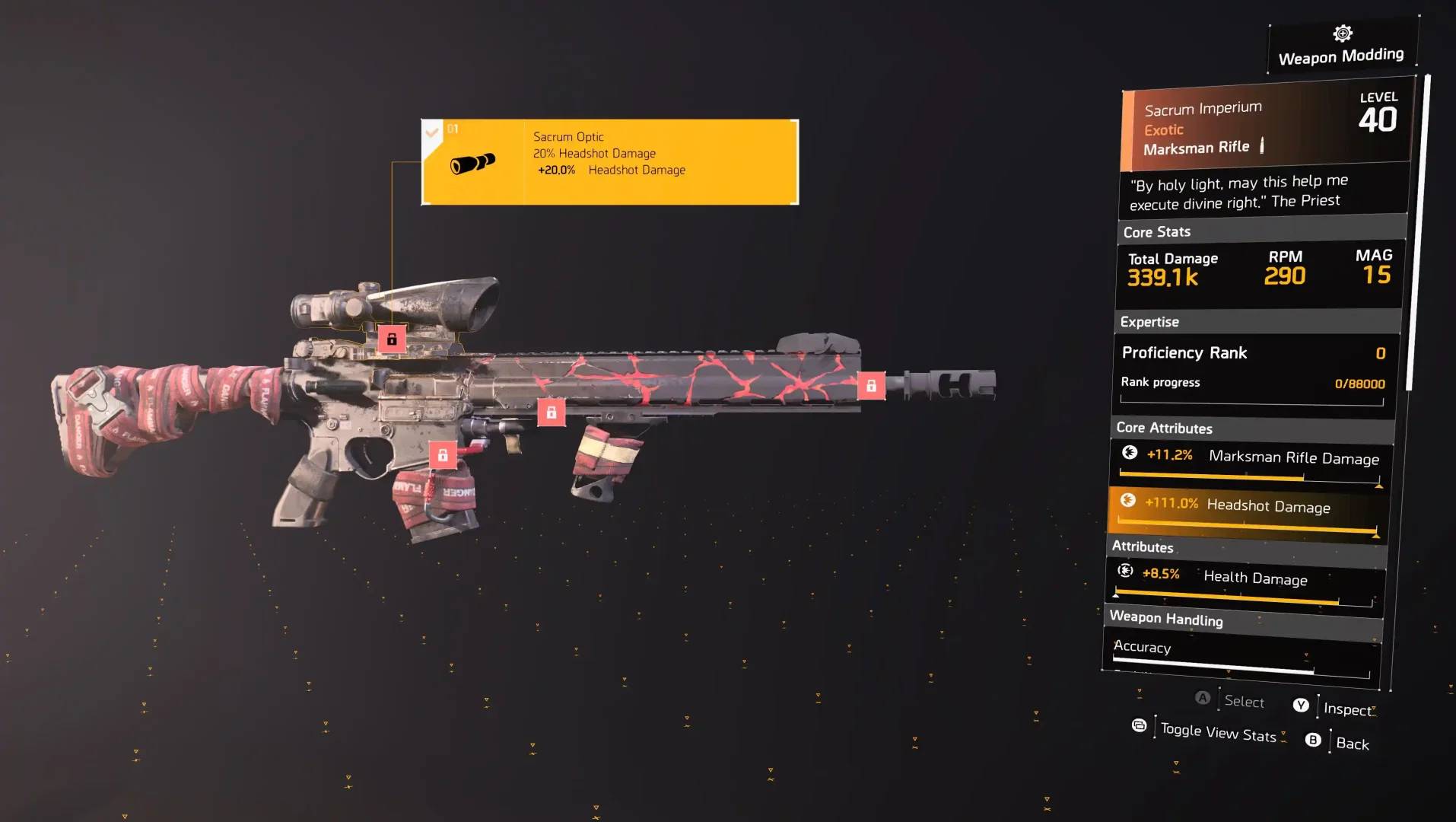
This one got announced almost as an afterthought during the Project Resolve reveal stream, but it might be the change with the longest shelf life. Starting with TU20, the third (bottom) attribute on every exotic weapon in the game became reconfigurable through the Tinkering Station.
Before this, exotic weapons were fixed. Whatever the third attribute rolled as, that’s what you had. If it didn’t synergize with your build, you either worked around it or swapped the weapon out. Massive’s own devs joked during the stream that everyone would immediately slot in Damage to Targets Out of Cover — and they were right. But the point is that this change effectively gave every exotic weapon a meaningful stat upgrade for players willing to engage with the Tinkering system.
Why this counts as a weapon buff in practice:
- An exotic that previously had a dead third attribute (say, a stat irrelevant to your build) now has a high-value damage attribute instead
- The effective power of exotic weapons went up for anyone who took the time to reconfigure — same base talent, better supporting stats
- For exotic LMGs specifically, this means weapons like Iron Lung can now be tuned more precisely to fit an LMG damage build rather than forcing you to compromise
The reconfiguration also combines cleanly with the broader Tinkering Station changes. Recalibration, optimization, and now exotic attribute swapping are all accessible from the same menu, which you can open directly from your inventory without going back to a base. That QoL improvement alone makes it faster to iterate on build ideas and actually test whether a reconfigured exotic improves your DPS before you fully commit.
If you haven’t touched your exotics since before TU20, open the Tinkering Station and check what your bottom attribute is doing. Swapping it out for something damage-relevant is one of the simplest ways to get more out of a weapon you’re already using.
How to Build Around All 3 Project Resolve Buffs in One Division 2 LMG Loadout
These three changes don’t need to be treated as separate improvements — they stack well together in a single build. Here’s how that looks in practice.
The foundation is a standard LMG from one of the buffed families. The M60 line is a strong pick for Legendary content because of the magazine size, which means longer windows of sustained fire between reloads. The RPK-74 is the better choice if you want slightly more manageable handling without giving up much on damage. Both got the full 20% buff in TU20.
For gear, commit to 3 pieces of a brand set with weapon damage or LMG-relevant bonuses. The reworked 3-piece bonuses make this worth the slot investment now, whereas before TU20 you’d have been better off mixing for raw stats. If you’re using the Striker Gear Set anywhere in the build, the 2-piece bonus gives an additional +15% LMG and AR damage — a clean synergy that stacks on top of the base weapon buff.
Slot in an exotic weapon or piece with a reconfigured third attribute tuned to damage. Damage to Targets Out of Cover is the obvious choice for PvE content. If your exotic is a secondary weapon, make sure the attribute swap makes sense for how often you’re actually drawing it — some builds use the exotic slot for a secondary burst weapon rather than the primary LMG.
Where this build performs best:
This isn’t the only way to use these changes, but it’s the most direct path to feeling all three buffs in practice. Start here, run a few Heroic missions, then adjust based on what’s holding back your damage.
Buy services for
The Division 2!
Get help with the parts of the game that take the most time. Browse available services or place a custom order.
Order
Final Verdict: Are These Division 2 Project Resolve Weapon Buffs Still Worth Using in 2026?
Yes — and across the board, not just for LMG specialists.
The 20% LMG damage buff is permanent and built into base weapon stats, so it carries forward into any future seasonal updates without needing to be refreshed or maintained. That makes it a reliable foundation for LMG builds going into 2026 content. The brand set rework is similarly baked in — the improved 3-piece bonuses aren’t temporary modifiers, they’re the new baseline for how those sets work.
The exotic reconfiguration is arguably the most durable change of the three because it scales with every new exotic weapon added to the game going forward. Each new exotic that drops now comes with a configurable third attribute, which means the system Massive built for Project Resolve keeps paying off as the loot pool expands.
If you’re returning to Division 2 after a break, start by visiting the Tinkering Station and checking your exotic attributes. Then pull out an M60 or RPK-74 and run a few Heroic missions — the LMG damage increase is noticeable enough that you’ll feel it within a couple of encounters. From there, start building toward a 3-piece brand set bonus that complements your weapon choice.
Project Resolve was a foundational overhaul, and these three buffs are the parts of it that still define the current meta. They’re not patch notes trivia — they’re practical tools worth using right now.
