












The open beta for Battlefield 6, held from August 14 to 18, 2025, marked the public’s first opportunity to experience DICE’s new vision for the legendary first-person shooter series. Thousands of players joined across PC, PlayStation, and Xbox, eager to see how the game would evolve after the mixed reception of Battlefield 2042.
The beta quickly sparked discussion — not because of bugs or performance, but because of the unusually small map sizes. For a franchise defined by vast battlefields, jets, and tank warfare, this was unexpected. Many players wondered: has Battlefield gone smaller on purpose?
The Intentional Shift Toward Smaller Maps
According to DICE lead producer David Sirland, the compact maps were not a downgrade but a deliberate design decision. The development team wanted to highlight Battlefield 6’s improved movement system, new destruction mechanics, and infantry gunplay before opening the door to full-scale warfare.
Sirland explained that map size has a direct impact on pacing: smaller maps produce faster matches and more frequent combat encounters, while larger maps slow down the tempo and reward long-term strategy. The beta, he said, was meant to show the “high-octane version” of Battlefield — close, loud, and chaotic — to stress-test the game’s core systems.
Internally, DICE used the beta to collect data on player flow, spawn balance, and combat density. Every choke point, respawn location, and capture zone was tracked to see how well players adapted to the new mechanics. The compact environments provided more consistent data since matches involved constant engagement rather than long travel times between objectives.
Larger Maps Are Confirmed
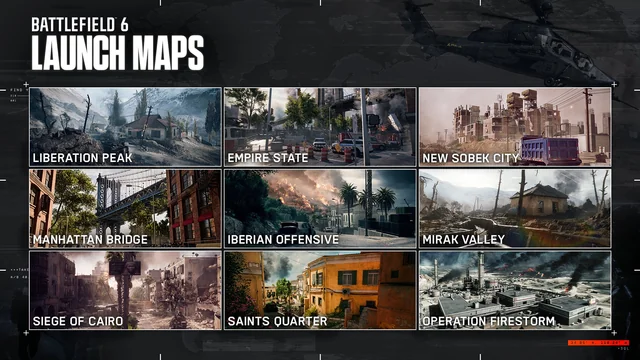
DICE has repeatedly reassured fans that the full game will include large-scale maps at launch. These maps will support vehicles, aircraft, dynamic weather, and up to 128 players on next-gen systems. They’re designed to recapture the sweeping, strategic battles that define the franchise.
Each large map reportedly follows a “multi-layer” design approach. Instead of one massive open plain, the environments are divided into interconnected combat zones — urban sectors, rural fields, mountain passes — each with distinct objectives and combat types. This layered design ensures that even large maps maintain consistent player density and avoid the “empty space” problem that plagued Battlefield 2042.
The development team also confirmed that the post-launch roadmap will expand the game’s map pool significantly. Seasonal updates will bring new environments, reimagined classics from older Battlefield titles, and experimental layouts designed for specific modes like Breakthrough+ and Hazard Operations.
Empire State and the Evolution of Map Design
The second week of the open beta introduced the new Empire State map, set in Brooklyn, New York. This level was a showcase of DICE’s new design philosophy — a hybrid of vertical and horizontal combat. Skyscrapers, subways, and rooftops allowed players to fight across multiple layers, emphasizing mobility and tactical positioning.
Empire State also demonstrated how smaller maps can still deliver variety and strategic depth. Fights could shift from tight hallways to open plazas in seconds, and destruction dynamically changed how players approached objectives. It was an early example of how Battlefield 6 aims to make every map feel alive and reactive.
Additional Features, Map Design Philosophy & What to Expect
- In an interview, design director Shashank Uchil said: “We start with the player experience — do we want high-density urban combat, or jets and tanks with open space?” Map size flows from that.
- Destruction remains a major pillar: Rather than huge “Levolution” events of past games, the team is focusing on tactical destruction, environments reacting under fire, dynamic cover and changing combat zones.
- The team also referenced lessons learned from Battlefield 2042 — that game aimed for ultra-large scale (128 players, massive maps) but many players felt it lacked “right feel”. Developers say BF6 brings the series back closer to what made earlier titles beloved.
- Post-beta adjustments: Based on feedback, devs note vehicle balance, spawn issues, mode mix and map variety will be tuned ahead of launch.
Community Feedback and Post-Beta Changes
After the beta concluded, DICE released a developer update addressing player feedback. Key areas of focus include refining spawn logic, improving visibility in high-density combat zones, and balancing weapon recoil patterns. The studio also promised to expand vehicle integration and rework certain objective layouts for the final release.
Performance optimization was another major takeaway. The beta’s smaller maps were easier to benchmark, helping DICE fine-tune server stability and latency under heavy load. This groundwork is crucial for ensuring that large-scale battles run smoothly at launch.
The Vision for the Full Game
When Battlefield 6 launches on October 10, 2025, it will feature a full suite of maps ranging from tight urban environments to massive open theaters. The campaign, multiplayer, and special co-op missions will share consistent physics, destruction, and AI systems, creating a seamless experience across modes.
The game will also reintroduce the classic Battlefield Commander System, letting squad leaders call in airstrikes, supply drops, and vehicle reinforcements in real time. This mechanic brings a layer of tactical depth back to large-scale multiplayer.
DICE has positioned Battlefield 6 as both a return to form and a technological showcase. The studio’s stated goal is to deliver the most responsive, balanced, and cinematic Battlefield to date — one that respects the franchise’s roots while adapting to modern gameplay expectations.
