











Crimson Desert throws you straight into the continent of Pywel with almost no hand-holding. One moment you’re learning a basic combo, the next you’re staring at six different upgrade menus, three playable characters, and a map that seems to go on forever. It’s a lot — and the in-game tutorials don’t always explain the things that actually matter.
This guide cuts through the noise. Whether you’re five minutes in or a few hours deep and already lost, everything here is focused on giving you a solid foundation: how combat works, how to actually get stronger, what to prioritize, and which mistakes will quietly cost you hours if you make them early.
Crimson Desert launched on March 19, 2026, for PS5, Xbox Series X|S, and PC. It’s a single-player open-world action-adventure developed by Pearl Abyss — and it’s one of the most mechanically dense games to come out this year.
What Kind of Game Is Crimson Desert — and Why Does It Feel So Overwhelming at First?
Crimson Desert started life as a spin-off of Black Desert Online, Pearl Abyss’s long-running MMORPG. But somewhere along the way it became something completely different: a massive single-player action-adventure built around exploration, physics-based combat, and a world that rewards curiosity.
The closest comparison? Think Devil May Cry’s combat depth mixed with Breath of the Wild’s open-world design philosophy. You’re not grinding levels or following a quest tracker. You’re exploring, fighting, and picking up pieces of power as you go.
The world is split across five distinct regions of the continent of Pywel — from the open grassy plains of Hernand to the harsh, arid depths of the Crimson Desert itself. Each region has its own faction dynamics, secrets, and challenges. And unlike a lot of open-world games, the difficulty scales with your progression, so you can’t just over-prepare in one zone and steamroll the next.
That last part is key. Crimson Desert’s Dynamic Difficulty Scaling system means the game stays challenging regardless of how much you’ve upgraded. It keeps things honest, but it also means you need to understand the systems — not just brute-force through them.
Make a breakthrough
in Crimson Desert!
Boost your progress in Crimson Desert with services built to save time and unlock what matters most. Get started.
View services
Meet Kliff — Your Starting Character and How Progression Actually Works
You play as Kliff, a mercenary and leader of the Greymanes — a band of fighters that’s been torn apart. The main story follows his attempt to find the surviving members and hold what’s left of the group together. He’s not a blank-slate hero. He has a personality, a history, and a way of reacting to the world that makes him immediately easy to root for.
As you progress through the narrative, two more playable characters unlock: Damiane and Oongka. Each brings a completely different combat style and their own set of questlines that run parallel to the main story. You’re not just swapping skins — you’re accessing entirely new playstyles and story threads.
| Character | Combat Style | When Available |
|---|---|---|
| Kliff | Versatile, combo-focused | From the start |
| Damiane | Fast, acrobatic | Unlocks during story |
| Oongka | Heavy, high-impact | Unlocks later in the story |
Here’s what’s unusual about progression: there are no experience points and no levels. Instead, you power up by exploring the world and defeating enemies. They drop Abyss Artifacts and enemy parts, which you convert into higher HP, more Stamina, new skills, better weapons, and armor. The game actively pushes you to go out and explore — staying in one area and grinding enemies isn’t the path forward.
The best three skills to prioritize early are Nature’s Echo, Quick Swap, and Blinding Flash. Unlock these before experimenting with other nodes.
Crimson Desert Combat Guide for Beginners — How Fighting Actually Works
Combat is where most new players struggle the longest. The inputs can feel slippery at first, and the game doesn’t always tell you the best way to use what you have.
First thing to change: stop tapping the attack button. Holding it down (R1 on PS5, LMB on PC) is far more effective than individual presses — it lets Kliff chain attacks automatically instead of pausing between each hit.
The watch and learn mechanic is one of the most important systems in the game. When an enemy performs a special move, Kliff can observe it. Let the enemy use the move multiple times during a fight, and Kliff will permanently learn the ability — without you spending a single Abyss Artifact to activate it. This is huge. Some of the best skills in the early game are available this way, and a lot of players miss it entirely.
A few other combat mechanics worth knowing from day one:
- Force Palm — Press it up to three times after jumping to gain a triple-boosted vertical jump. Useful for both traversal and aerial combat
- Parries, dodges, and grapples — all function like a fighting game. Timing and positioning matter more than raw damage output
- Weapon drops — enemies can knock your weapon out of your hand mid-fight. Keep track of where it lands and pick it up. Losing your weapon in a tough fight can turn a close win into a wipe
- Axiom Bracelet — tied to some of Crimson Desert’s deeper systems. Pay close attention to how it interacts with your equipped abilities as you unlock more of them
Stamina is more important than HP in most early boss fights. It controls your ability to block, sprint, and attack. Invest in it early via Abyss Artifacts.
Crimson Desert World Exploration Tips — How to Get Stronger Through Pywel
Exploration isn’t a side feature in Crimson Desert — it’s the main progression loop. Almost every meaningful upgrade comes from going out into the world.
- Bell towers are your first priority in any new city or town. Climb them and ring the bell to remove the fog of war from the surrounding region and reveal points of interest on the map. It works exactly like the viewpoints in Assassin’s Creed, and it saves you a lot of aimless wandering.
- Upgrade your Greymane Camp as soon as it becomes available. It provides unique items and bonuses that you won’t find anywhere else, and neglecting it in the early game means missing out on significant advantages.
The question mark icons on the map hide two types of secrets — both worth tracking down:
- Abyss Nexus points — fast travel locations that open up navigation significantly
- Abyss Cressets — unlocked through puzzles and reward you with an Abyss Artifact on top of fast travel access
Keep an eye out for strange cubes on roadside rocks as you travel through Pywel. These are challenge objects — complete the associated challenge to earn Abyss Gears for your equipment slots and sometimes Faded Abyss Artifacts, which can be used for a respec.
Inventory Management, Loot, and Silver — What New Players Overlook
The default inventory is small. Uncomfortably small. The good news is that most merchants across Pywel sell a cheap bag that adds one inventory slot, and there are a lot of merchants.
Talk to every shopkeeper you meet — even the fishing gear vendor, even the one who seems irrelevant. In the first few hours of the game, you can easily gain 10 to 12 extra inventory slots just by chatting with every trader you pass. It costs almost nothing and the difference is immediate.
Sealed Artifacts are collectibles you’ll find scattered throughout the world. They contain Abyss Cores (skill points) locked inside. To unlock one, pause the game, go to Journal → Challenges, and check what’s required for each Sealed Artifact you’re holding. Complete the challenge, unseal the artifact, and claim the skill point. Many players carry these for hours without knowing what to do with them.
Silver is the main currency, and you need it constantly — for gear, crafting materials, and upgrade components. Two reliable early sources:
- Investing in a bank (gives passive returns over time)
- Gambling minigames found in larger settlements
Buy a pickaxe and an axe from a merchant as early as possible. Ore and wood are core crafting materials and you’ll need both constantly for gear upgrades.
Gear Upgrades, Crafting, and the Best Early Weapons
Upgrading your gear at a blacksmith isn’t optional. Against multi-phase bosses, the gap between upgraded and unupgraded equipment is substantial — you’ll feel it.
Most early refinement tiers only require copper and iron ore, which are common throughout Pywel. The top tier of refinement requires Bloodstone, which is rarer but worth hunting for once you’ve covered the basics. Keep an eye out for Grindstones and Anvils in the world — they provide temporary buffs to weapon effectiveness (Grindstone) or armor effectiveness (Anvil) and can make difficult encounters more manageable.
Crafting weapons from scratch is also worth your time. Crafted weapons provide stat bonuses and can enhance specific skills in ways that looted gear often doesn’t replicate. Don’t treat it as an endgame activity.
The two strongest weapons for the early game are:
Both are significantly better than most early loot, so prioritizing these boss fights once they’re available pays off quickly.
Professions and Life Skills — Why You Shouldn't Skip Them
Crimson Desert has a full suite of life skills: cooking, fishing, hunting, mining, woodcutting, and more. They’re not padding. Each one feeds directly into combat performance or resource gathering in a way that matters.
Cooking is the most important one to pick up first. Cooked food provides pre-fight buffs that make boss encounters noticeably easier. Before any significant fight, you want a meal active. To farm meat fast: sprint toward groups of animals and use your special attack (R1 + R2 on PS5) to take out multiple deer or goats at once. Loot the meat, find a campfire or cooking pot, and cook it. To eat during combat, hold right on the D-pad to assign food, then tap right to consume it.
Mining and woodcutting feed directly into gear upgrades — buy the tools early and use them whenever you pass resource nodes. Fishing and hunting are lower priority initially but provide additional Silver and crafting materials as you get more established.
How to Beat Crimson Desert Bosses — What You Actually Need to Know Before Each Fight
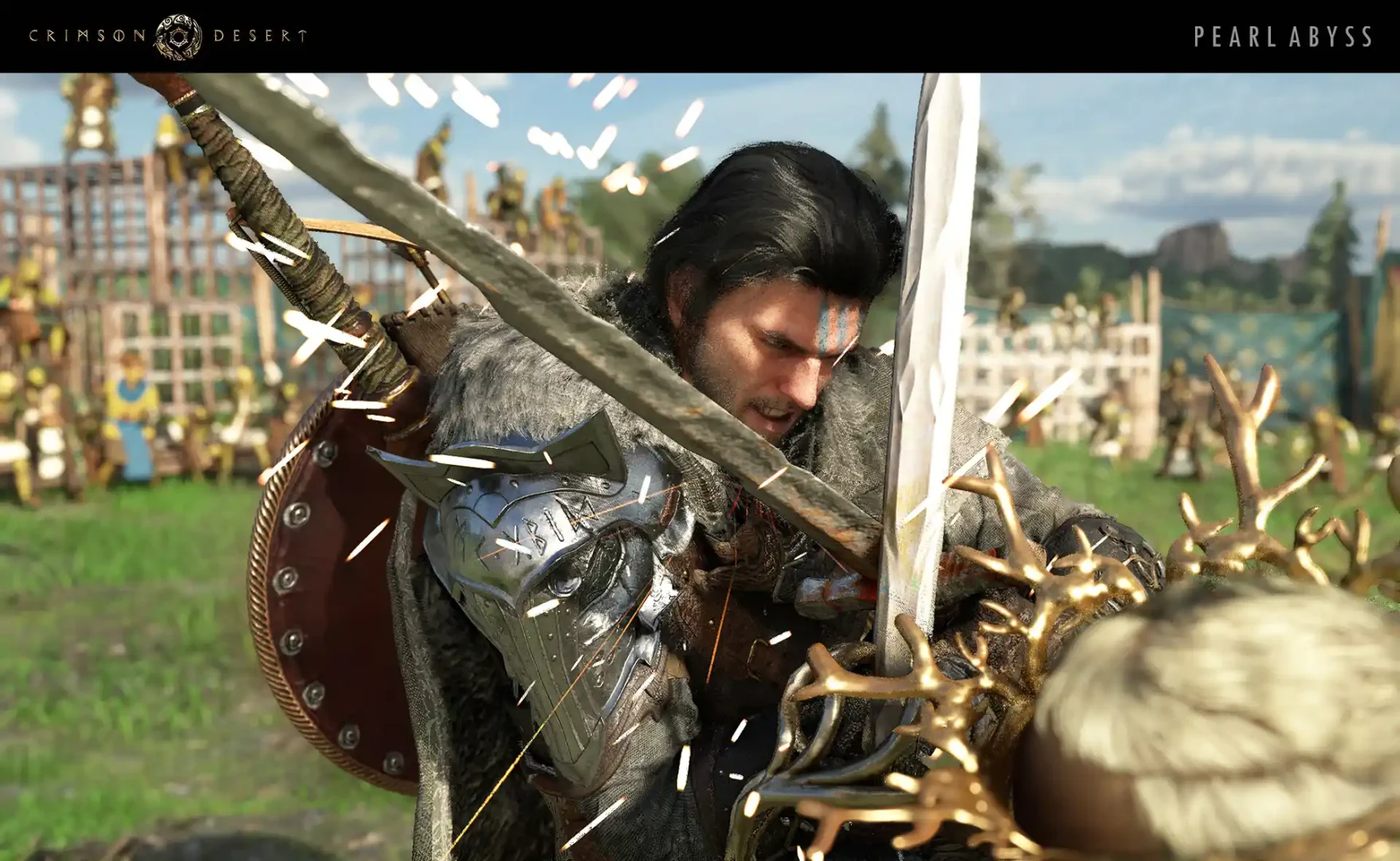
Bosses in Crimson Desert are structured in phases. When you drain the first health bar, a cutscene triggers, the HP resets, and the fight escalates in difficulty. Don’t get caught off guard by this — it’s not a bug.
Bring food. A lot of food. Some of the earlier boss fights are tuned aggressively, and without a healing option mid-fight, they can become frustrating very quickly. Brute-forcing a boss without consumables is a waste of time when the fix is as simple as cooking before the encounter.
Revive Orbs are glowing collectibles found throughout main quests. When you die with one active, you respawn at 30% HP instead of restarting from the beginning or the checkpoint. They’re situationally valuable — hold onto them for bosses rather than burning them on regular encounters.
Against humanoid bosses, one of the most reliable early tactics is the knockdown combo: sprint directly at the enemy, press F (Y on controller) to deliver a running kick, and follow up while they’re down. It works consistently in the first half of the game and deals with aggressive enemies before they can get into their attack patterns.
Navigation, Fast Travel, and Mounts in Crimson Desert
Getting around Pywel efficiently starts with unlocking fast travel points. Abyss Nexus locations are hidden behind the question mark icons on the map — finding and activating them should be a consistent priority as you explore each new region. Abyss Cressets serve double duty as fast travel points and give you an Artifact for your trouble.
Horses are your main transport for medium-distance travel. You can tame and level them up — a leveled horse makes a significant difference in how efficiently you can move between objectives. Later in the game, additional mounts become available including a dragon and a mechanical mount, both of which can be used in combat.
One important note for PC players: play with a controller. The game is designed around analog inputs, and mouse-and-keyboard controls are noticeably less responsive for combat. A PlayStation or Xbox controller is strongly recommended from the start.
Key Menus Every New Player Should Know About
The game tracks a lot of information that’s easy to miss because it’s buried in menus. These are the ones worth knowing from the beginning:
- Journal → Faction Quests — quest chains tied to specific regions and factions like the Greymanes and Hernand
- Journal → Challenges — where you track and complete Sealed Artifact challenges to unlock Abyss Cores
- Others → Knowledge — records everything you’ve learned about NPCs, factions, collectibles, and bosses
- Others → Guides — lets you re-read any tutorial tooltip you’ve previously encountered
- Others → Notifications — shows missed pop-up tips from when you were too focused on combat to read them
If you ever feel like you’ve missed something or can’t remember how a mechanic works, check here before looking it up externally.
Make a breakthrough
in Crimson Desert!
Boost your progress in Crimson Desert with services built to save time and unlock what matters most. Get started.
View services
10 Beginner Mistakes That Will Cost You Hours in Crimson Desert
These are the errors that slow down almost every new player. Most of them are easy to avoid once you know they exist:
- Tapping the attack button instead of holding it — this is less efficient and breaks your combo flow
- Ignoring merchants and missing out on 10+ free inventory slots in the first few hours
- Not upgrading the Greymane Camp when it becomes available
- Carrying Sealed Artifacts for hours without checking Journal → Challenges to unlock them
- Skipping food buffs before boss fights, then complaining the bosses are too hard
- Not unlocking Abyss Nexus fast travel points before pushing into new areas
- Spending Abyss Artifacts on skills that can be learned for free through the watch-and-learn mechanic
- Not picking up your weapon after it gets knocked out of your hand mid-fight
- Skipping blacksmith upgrades and wondering why bosses hit so hard
- Playing on PC with mouse and keyboard when a controller makes combat significantly more manageable
Final Thoughts
Crimson Desert has a steeper learning curve than most open-world games, but it evens out quickly once you understand what it’s asking of you. The combat, the exploration, the systems — they all start clicking once you stop fighting against them and start working with them.
The three things that will make the biggest difference early: keep exploring (that’s how you get stronger), upgrade your gear at the blacksmith before major fights, and always check your Sealed Artifacts so you’re never leaving skill points on the table.
From there, the game opens up considerably — and there’s a lot worth seeing in Pywel.
